
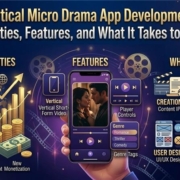
Vertical Micro Drama App Development: Opportunities, Features, and What It Takes to Build One
The streaming industry has a new favorite format — and it is not Netflix-style long-form content. Vertical micro drama apps are pulling millions of users away from traditional platforms, and businesses that recognize this shift early are the ones building the next generation of entertainment products.
But for most companies exploring this space, the same questions come up: What does it actually cost to build one? How long does it take? What features matter? And who do you trust to build it right?
This article answers all of that.
What Is a Vertical Micro Drama App?
A vertical micro drama app is a mobile-first streaming platform that delivers short, episodic drama content — typically 1 to 5 minutes per episode — in a vertical, full-screen format optimized for smartphones. Think of it as the drama version of TikTok, but with structured storylines, cliffhangers, and strong monetization built in.
Platforms like DramaBox, ReelShort, and ShortTV have proven the model works. Users are highly engaged, session times are long despite short episode lengths, and the monetization through subscriptions and coin-based unlocks generates consistent revenue.
The Business Opportunity — And Why Most Companies Miss It
The global micro drama market is expanding rapidly across North America, Southeast Asia, South Asia, and the Middle East. The demand is there. The audience is there. Yet most businesses hesitate to enter because they hit the same wall — they do not know where to start technically, and they do not want to invest heavily without clarity on what they are building.
That hesitation is exactly what competitors are exploiting.
Content studios, media companies, and digital entrepreneurs who move now have a genuine first-mover advantage in their region or niche. Those who wait will enter a more crowded market at a higher cost.
The Real Pain Points Businesses Face When Building a Micro Drama App
- No clear technical roadmap Most business owners know what they want the app to do but have no idea how to scope it technically. Without a clear roadmap, projects drag, budgets balloon, and launches get delayed by months.
- Feature bloat vs. MVP confusion There is always pressure to build everything at once. But trying to launch with every feature leads to long development cycles and wasted resources. Knowing what to build first is half the battle.
- Finding a development partner who understands the format Generic app developers can build apps. Not all of them understand the specific architecture that a vertical streaming platform requires — content delivery, episode unlock logic, monetization flows, and a CMS built for drama series management.
- Monetization complexity Building a platform is one thing. Building one that actually makes money requires careful integration of subscription tiers, coin systems, in-app purchases, and payment gateways — all working seamlessly together.
- Time to market The micro drama space is moving fast. A 12-month development cycle is not viable for most businesses trying to enter now.
What a Well-Built Vertical Micro Drama App Needs
If you are serious about entering this market, your platform needs to be built around these core capabilities:
Content Experience Vertical full-screen video player, smooth episode-to-episode navigation, offline viewing support, and adaptive streaming for varying network conditions. The viewing experience is everything — a single buffering issue can lose a user permanently.
Monetization System A flexible monetization layer is non-negotiable. This means subscription plans, a coin or credit system for episode unlocks, in-app purchase integration, and support for multiple payment gateways across regions.
Content Management Operators need a robust CMS to upload drama series, manage episode releases, schedule content drops, and organize their library. Without this, managing even a modest content catalog becomes a daily headache.
User Engagement Tools Personalized content feeds, push notifications, watch history, bookmarks, and social sharing features keep users coming back. Retention is where platforms win or lose.
Admin and Analytics Dashboard A real-time dashboard covering user activity, revenue, content performance, and subscription metrics gives operators the visibility they need to make fast decisions.
Scalability A platform that works for 1,000 users must also work for 100,000. The backend architecture needs to be built for scale from day one, not retrofitted later.
Build Custom or Go White-Label?
This is one of the first decisions businesses need to make — and the right answer depends on timeline and budget.
A fully custom vertical micro drama app development gives you complete control over design, features, and architecture. It is the right choice for businesses with a specific vision, a differentiated content strategy, and the runway to build properly.
For businesses that need to move faster, a white-label DramaBox clone offers a production-ready framework that can be branded, configured, and launched in a fraction of the time. The core infrastructure is already built — you customize it to fit your brand and content library.
Both paths lead to the same destination. The choice is about how quickly you need to get there and how much differentiation matters at launch.
What It Takes to Build One — And Who Should Build It
The biggest mistake businesses make is treating a micro drama app like a standard mobile app project. It is not. It sits at the intersection of streaming technology, content management, and monetization systems — and it requires a development partner who has worked in that intersection before.
You need a team that understands video delivery infrastructure, not just front-end design. You need monetization logic built into the architecture from the start, not added on later. And you need a CMS that your content team can actually use without engineering support every time they upload a new series.
This is exactly the gap that Triple Minds fills. As a specialized development agency, Triple Minds offers both fully custom vertical micro drama app development and white-label solutions for businesses that want to launch quickly under their own brand.
Final Word
The vertical micro drama market is not waiting for anyone. Businesses that act now — with the right technology partner and a clear product strategy — are the ones that will own audience attention in their niche over the next few years.
The format is proven. The demand is real. The only question is whether your business is positioned to capture it.
Frequently Asked Questions
- How long does it take to develop a vertical micro drama app from scratch? A fully custom vertical micro drama app typically takes between 3 to 6 months depending on the feature set, design complexity, and backend requirements. Businesses that opt for a white-label solution can significantly cut that timeline — often launching within 4 to 8 weeks. The key factor is how clearly the requirements are defined at the start. A well-scoped project moves faster and costs less than one that evolves mid-development.
- What is the difference between a custom build and a white-label micro drama app? A custom build is developed from the ground up based on your specific requirements — giving you full control over design, features, and architecture. A white-label solution is a pre-built, production-ready platform that is rebranded and configured for your business. Custom builds are ideal for businesses with a unique product vision and a longer runway. White-label is the right choice when speed to market is the priority and the core feature set meets your needs.
- How do micro drama apps make money? The most effective micro drama platforms use a combination of monetization models. Subscription plans give users unlimited access for a recurring fee. Coin or credit systems let users purchase virtual currency to unlock individual episodes — this model drives high impulse purchases and strong per-user revenue. In-app advertising adds an additional layer for free-tier users. The most successful platforms combine at least two of these models to maximize revenue across different user segments.
- Do I need a large content library before launching? No. Many successful micro drama platforms launched with a focused catalog of 5 to 10 series and grew their library over time. What matters more at launch is content quality and the consistency of your release schedule. A platform that drops new episodes regularly retains users far better than one that launches with a large library and then goes quiet. Your technology should support a rolling release strategy from day one.
- Can the app support multiple languages and regions? Yes, and for most businesses this is not optional — it is essential. A well-built micro drama app should support multi-language subtitles, localized payment gateways, and region-specific content libraries. If your growth strategy includes markets across South Asia, Southeast Asia, or North America simultaneously, the platform architecture needs to account for that from the start rather than being adapted later at additional cost.
- What ongoing support is needed after the app launches? Launching the app is the beginning, not the end. Post-launch, businesses need regular performance monitoring, server scaling as the user base grows, bug fixes, OS compatibility updates, and feature additions based on user feedback. A reliable development partner should offer structured post-launch support — not just hand over the code and disappear. At Triple Minds, ongoing support and maintenance is a core part of the engagement, ensuring the platform stays stable and competitive as the market evolves.