
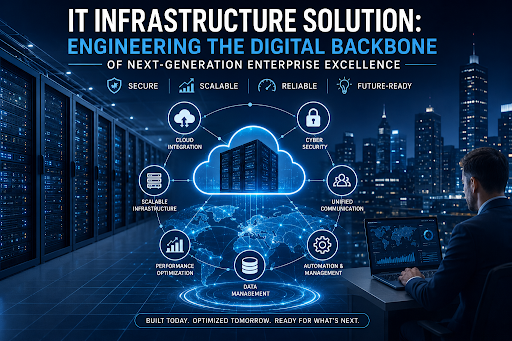
IT Infrastructure Solution Engineering the Digital Backbone of Next-Generation Enterprise Excellence
In today’s hyper-connected digital economy, organizations depend on technology more than ever before. Every customer interaction, business transaction, internal process, and strategic decision relies on a robust technological foundation. While innovative software and advanced applications often receive the spotlight, the real force enabling these capabilities operates behind the scenes. This force is the it infrastructure solution that supports every aspect of digital business operations.
As enterprises expand, technological complexity increases. Businesses must manage growing amounts of data, support remote workforces, strengthen cybersecurity, and maintain uninterrupted operations. Consequently, organizations require a comprehensive and scalable infrastructure strategy. A well-designed it infrastructure solution provides the framework needed to achieve these goals while maintaining performance, security, and operational efficiency.
Section 1 Decoding the Foundation What Is an IT Infrastructure Solution?
An it infrastructure solution refers to the complete ecosystem of hardware, software, networks, storage systems, cloud resources, and management tools that support an organization’s technology operations. It creates the foundation upon which business applications, communication systems, and digital services function effectively.
Rather than viewing infrastructure as merely servers and cables, modern enterprises recognize it as a strategic business asset. Infrastructure solutions integrate multiple technologies into a unified framework that enables seamless data flow, efficient resource allocation, and secure operations. As a result, organizations gain greater visibility, control, and flexibility across their technology environments.
Furthermore, infrastructure solutions continue to evolve. Traditional on-premises systems now coexist with cloud platforms, edge computing technologies, and intelligent automation tools. This evolution allows businesses to adapt quickly to changing market conditions while maintaining operational stability.
Section 2 The Strategic Shift from Support Function to Business Driver
Historically, IT infrastructure served primarily as a support mechanism. Organizations invested in servers, networking equipment, and storage systems mainly to keep operations running. However, digital transformation has dramatically changed this perspective.
Today, executives view infrastructure as a strategic enabler of innovation and competitive advantage. Modern businesses leverage infrastructure to launch new services, improve customer experiences, accelerate product development, and enter new markets. Consequently, infrastructure decisions directly influence organizational growth and profitability.
Moreover, an advanced it infrastructure solution empowers leadership teams to make data-driven decisions. Through enhanced connectivity, real-time analytics, and scalable computing resources, organizations can respond rapidly to emerging opportunities and challenges. This strategic role makes infrastructure a critical component of long-term business planning.
Section 3 Building Blocks of a Modern IT Infrastructure Solution
Every successful infrastructure strategy relies on several interconnected components working together seamlessly. These foundational elements create the digital backbone that supports enterprise operations.
Hardware Infrastructure
Physical hardware remains essential despite the rise of cloud computing. Servers, storage arrays, networking devices, workstations, and data center equipment provide the computational power required to process business workloads.
Modern hardware solutions focus on performance, reliability, and scalability. Organizations increasingly adopt high-performance servers and intelligent storage systems capable of handling growing data demands while maintaining operational efficiency.
Network Infrastructure
Networks serve as the communication highways connecting users, applications, devices, and data resources. Without reliable connectivity, even the most advanced technology environments become ineffective.
Modern network infrastructure incorporates software-defined networking, wireless connectivity, virtual private networks, and advanced traffic management technologies. These capabilities improve performance while supporting hybrid and remote work environments.
Software and Management Platforms
Infrastructure management software enables organizations to monitor, optimize, and secure their technology environments. These platforms provide centralized visibility across complex systems, reducing administrative burdens and improving operational efficiency.
Additionally, automation tools streamline repetitive tasks, minimize human error, and accelerate infrastructure deployment processes. As a result, IT teams can focus on strategic initiatives rather than routine maintenance activities.
Section 4 Cloud Integration Transforming Infrastructure for the Digital Age
Cloud computing has fundamentally changed how businesses approach infrastructure management. Instead of relying solely on physical hardware, organizations can access computing resources on demand through cloud platforms.
This transformation offers significant advantages. Businesses gain flexibility, scalability, and cost efficiency while reducing the need for large capital investments. Furthermore, cloud environments support rapid deployment of applications and services, allowing organizations to respond quickly to changing business requirements.
However, successful cloud adoption requires careful planning. A comprehensive it infrastructure solution integrates cloud resources with existing systems while maintaining security, compliance, and operational consistency. Hybrid and multi-cloud strategies often provide the ideal balance between flexibility and control.
Section 5 Cybersecurity as the Cornerstone of Infrastructure Excellence
As cyber threats become increasingly sophisticated, security has evolved from a standalone concern into a core infrastructure requirement. Every infrastructure component must contribute to a comprehensive defense strategy.
Organizations face risks ranging from ransomware attacks and data breaches to insider threats and advanced persistent attacks. Therefore, infrastructure solutions must incorporate multiple layers of protection, including firewalls, intrusion detection systems, endpoint security tools, and encryption technologies.
Moreover, proactive security monitoring plays a crucial role in identifying vulnerabilities before they become major incidents. By integrating cybersecurity directly into infrastructure design, businesses can reduce risk while maintaining regulatory compliance and customer trust.
Section 6 Scalability and Flexibility Preparing for Future Growth
Business growth rarely follows a predictable path. New customers, expanding product lines, acquisitions, and evolving market demands can rapidly increase technology requirements. Therefore, scalability has become one of the most important characteristics of a modern it infrastructure solution.
Scalable infrastructure allows organizations to add computing power, storage capacity, and network resources without disrupting operations. Instead of replacing entire systems when demand increases, businesses can expand incrementally and cost-effectively. This approach reduces downtime while ensuring continuous service delivery.
Flexibility is equally important. Today’s organizations operate in dynamic environments where priorities can shift quickly. Infrastructure must support new applications, emerging technologies, and changing workforce requirements. A flexible infrastructure framework enables businesses to adapt rapidly while maintaining operational stability.
Furthermore, scalable solutions improve investment efficiency. Companies avoid overprovisioning resources while retaining the ability to respond immediately when growth opportunities arise. Consequently, infrastructure becomes a catalyst for innovation rather than a limitation.
Section 7 Data Management Fueling Intelligence Through Infrastructure
Data has become one of the most valuable business assets in the digital era. Every transaction, customer interaction, operational process, and strategic initiative generates information that can drive better decision-making. However, data only delivers value when organizations can store, manage, protect, and analyze it effectively.
A modern it infrastructure solution provides the storage architecture and management capabilities necessary to support growing data volumes. Advanced storage technologies enable rapid access to information while maintaining reliability and security. This capability becomes increasingly important as businesses embrace artificial intelligence, machine learning, and advanced analytics.
Additionally, infrastructure supports data governance initiatives by ensuring information remains accurate, accessible, and compliant with regulatory requirements. Organizations can establish consistent policies for data retention, backup, recovery, and protection across the entire enterprise.
When infrastructure and data strategy align, businesses gain actionable insights faster. Leaders can make informed decisions based on real-time information, improving efficiency, customer satisfaction, and competitive positioning.
Section 8 Automation and Artificial Intelligence in Infrastructure Management
The complexity of modern technology environments continues to grow. Managing thousands of devices, applications, users, and workloads manually is no longer practical. Consequently, automation and artificial intelligence have become essential components of advanced infrastructure strategies.
Automation eliminates repetitive administrative tasks such as software updates, system provisioning, performance monitoring, and incident response. By reducing manual intervention, organizations improve consistency while minimizing human error. IT teams can redirect their efforts toward strategic projects that deliver greater business value.
Artificial intelligence takes infrastructure management a step further. AI-powered tools analyze vast amounts of operational data to identify patterns, predict failures, and optimize resource utilization. These capabilities enable proactive management rather than reactive troubleshooting.
Moreover, intelligent infrastructure platforms continuously learn from operational behaviors. As a result, they can recommend improvements, strengthen security measures, and enhance performance automatically. This evolution transforms infrastructure management from a labor-intensive process into a strategic business capability.
Section 9 Supporting Hybrid Work and Digital Collaboration
The workplace has undergone a dramatic transformation. Employees increasingly work from multiple locations, collaborate across time zones, and access business resources through diverse devices. This shift has elevated the importance of a resilient and adaptable it infrastructure solution.
Infrastructure must provide secure access to applications, data, and communication tools regardless of employee location. Virtual private networks, cloud collaboration platforms, identity management systems, and endpoint security solutions work together to create seamless user experiences.
In addition, organizations must maintain consistent performance across distributed environments. Slow connections, unreliable access, or security vulnerabilities can negatively impact productivity and employee satisfaction. Therefore, infrastructure investments directly influence workforce effectiveness.
As hybrid work models continue to evolve, infrastructure will remain a critical factor in attracting talent, supporting collaboration, and maintaining operational continuity. Businesses that invest in flexible technology foundations position themselves for long-term workforce success.
Section 10 Engineering the Future Emerging Trends Shaping IT Infrastructure
Technology innovation continues to reshape infrastructure strategies. Organizations that understand these trends can make informed investments and prepare for future opportunities.
One significant development is edge computing. Rather than processing all data in centralized locations, edge environments perform computations closer to the source of data generation. This approach reduces latency, improves performance, and supports real-time applications.
Another important trend involves sustainability. Businesses increasingly prioritize energy-efficient infrastructure designs to reduce environmental impact and operational costs. Green data centers, optimized cooling systems, and efficient hardware technologies contribute to these objectives.
Furthermore, infrastructure modernization increasingly incorporates artificial intelligence, advanced cybersecurity frameworks, containerization technologies, and distributed cloud architectures. Together, these innovations create more resilient, intelligent, and scalable environments capable of supporting next-generation business initiatives.
Organizations that embrace these advancements gain a significant competitive advantage. Their infrastructure becomes a platform for continuous innovation, enabling them to respond confidently to evolving market demands and technological opportunities.
Conclusion:
Modern organizations operate in an environment defined by connectivity, data, innovation, and rapid change. Success depends not only on visionary leadership and innovative products but also on the technology foundation that supports every business function.
A comprehensive it infrastructure solution serves as the digital backbone of enterprise excellence. It connects people, applications, processes, and information within a unified framework designed for performance, scalability, security, and resilience. More importantly, it enables businesses to transform challenges into opportunities and ideas into measurable outcomes.
As technology continues to evolve, infrastructure will play an increasingly strategic role in organizational success. Businesses that invest in modern, intelligent, and future-ready infrastructure solutions position themselves to thrive in a competitive digital economy.
Rather than viewing infrastructure as a technical necessity, forward-thinking organizations recognize it as a critical business asset. Through careful planning, continuous optimization, and strategic investment, they can build the foundation required for sustainable growth and long-term excellence.
Frequently Asked Questions (FAQ)
1. What is an IT infrastructure solution?
An it infrastructure solution is a comprehensive framework of hardware, software, networking, storage, cloud resources, and management tools that support an organization’s technology operations and business objectives.
2. Why is IT infrastructure important for businesses?
IT infrastructure supports daily operations, enhances productivity, strengthens cybersecurity, enables scalability, and provides the technological foundation required for digital transformation initiatives.
3. What are the main components of an IT infrastructure solution?
Key components include servers, storage systems, networking equipment, cloud platforms, cybersecurity tools, management software, and data backup solutions.
4. How does cloud computing improve infrastructure?
Cloud computing increases flexibility, scalability, cost efficiency, and accessibility while enabling organizations to deploy resources quickly and respond to changing business needs.
5. How can businesses improve their IT infrastructure?
Organizations can improve infrastructure by modernizing hardware, adopting cloud technologies, implementing automation, strengthening cybersecurity measures, and continuously monitoring performance.
6. What role does cybersecurity play in infrastructure?
Cybersecurity protects infrastructure from threats such as ransomware, malware, data breaches, and unauthorized access while ensuring business continuity and regulatory compliance.
7. Is a scalable infrastructure necessary for small businesses?
Yes. Scalable infrastructure allows small businesses to grow efficiently without requiring costly system replacements as operational demands increase.
8. How does infrastructure support digital transformation?
Infrastructure provides the technological foundation needed to implement advanced applications, data analytics, cloud services, automation, and other digital transformation initiatives.

Leave a Reply
Want to join the discussion?Feel free to contribute!