
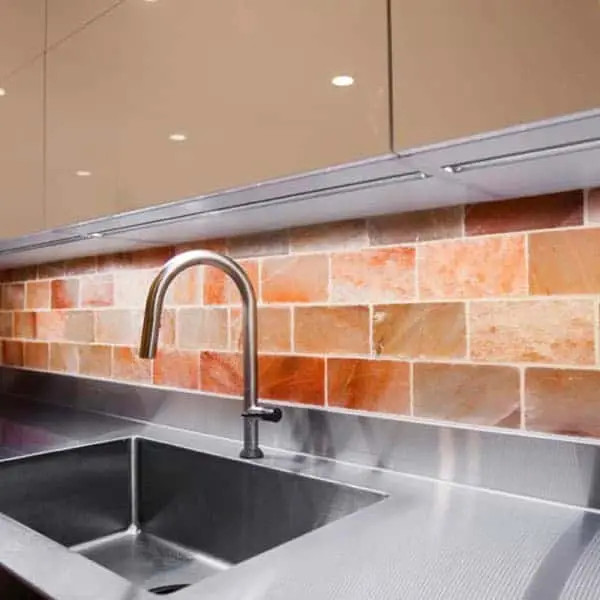
Himalayan Salt Bricks Walls for Kitchen Interior
For decades, the gold standard of luxury kitchens was gleaming clinical precision: bright white salt tiles, stark marble countertops, and cool-toned LED lighting. And though it’s clean and functional, that aesthetic can make the “heart of the home” feel a little cold. Homeowners and interior designers are starting to turn instead to materials that bring warmth, texture, and an organic touch into the home.
There are Himalayan Salt Bricks walls.
You may have seen the soft amber light of a salt lamp on a bedside table, but taking that concept to architectural scale can turn it into a stunning visual statement. Himalayan salt bricks in a kitchen -the risk takes rustic organic texture and combines it with elegant lighting. It transforms a practical room into an atmospheric sanctuary. Apart from their sheer visual appeal, these walls offer several advantages that the ordinary ceramic or stone type cannot emulate in your home surroundings.
What Are Himalayan Salt Bricks?
Before you spend your weekends shopping around for a renovation, it’s good to get to know the material. These bricks are cut from solid pink rock salt found in the areas surrounding the Himalayas in Pakistan. The color of the salt is obvious enough: Anyone could look at a Himalayan block and see that it’s slightly translucent, with veins of pink, red, or white impurities (primarily iron oxide) running through it.
For building and decorative use, the salt is cut into regular bricks or salt tiles. Tiles are also in white with natural gradient inside, and its look like marble tile called white salt tiles. As a natural product, there are no two bricks the same. Some are translucent and ice-cold, others dense with deep color. Once assembled into a wall, this variation creates a visually rich trellis-like pattern that looks great even when off. But it’s the real magic when we add light.
The Artistic Effect: Writing with Light
The reason designers are reaching for salt walls is the way they play with light. Salt crystal is transparent, unlike white salt tiles or opaque drywall. When a light is situated behind a wall of salt (backlighting), the bricks will emit a warm, subtle glow due to the diffusion of light.
Setting the Mood
Over-lighting with mean little task lighting is a trend in kitchens. A backlit wall of salt provides a second layer of illumination; it’s strictly atmospheric. It pulls its warm hue from a sunset or the burning embers in a fire. That makes the kitchen a more welcoming space for entertaining or unwinding with a glass of wine once the cooking is over.
Texture and Depth
Salt bricks also provide ample texture, even without backlighting. In contemporary kitchens with minimalist cabinets and slick appliances, the rough or honed texture of salt lends needed contrast. It’s a mix of modern minimalism and quaint country charm, flexible enough to be in your farmhouse kitchen or in a sharp-looking city penthouse.
The New Rules of Engagement for Wellness Centers
The benefits are aesthetically satisfying, but many enthusiasts of Himalayan salt features suggest there may be wellness gains, too. The idea is rooted in halotherapy (salt therapy).
Salt, when heated, is said to release negative ions into the atmosphere. In principle, these negative ions can attach to positive ions (which are often produce by electronic devices and pollutants), neutralize them, and make the air cleaner. Although the scientific community can’t agree on the degree of such health benefits within a living space, many homeowners say that having a salt wall has made their air feel cleaner and more invigorating and helps them de-stress.
In the kitchen, salt’s antimicrobial effect is a practical advantage as well. Salt is naturally anti-bacterial and mold-resistant. And while you certainly wouldn’t adopt your wall as a cutting board, it doesn’t hurt to feel good knowing that your architectural features are naturally clean and, above all else, hygienic in a space designed for handling food.
Practical Considerations for Kitchen Installation
It’s easy to install a salt wall in a living room or sauna, but the kitchen comes with a whole different set of issues, namely, moisture and heat. Salt is hygroscopic, so it draws moisture out of the air. In a very humid and poorly ventilated kitchen, Himalayan salt bricks might begin to “weep” (sweat).
Placement Matters
It’s all about placement to last the lifetime of your feature.
1.) Avoid Near Direct Splash Zones: Do not place a seat directly behind and above a sink or stove where there will be a concentrated splash of steam (stovetop), similar to over a stovetop, especially if you have hard water. Direct water contact will eventually wash the salt away.
Dry Accent Walls: The ideal spots are breakfast nooks, the front of a kitchen island (but away from the dishwasher), or just a feature wall near your pantry or wine fridge.
Ventilation: Make sure your kitchen is fit with a good-quality range hood and that there’s plenty of air flow. This helps to regulate the humidity, which in turn will help to keep your salt in perfect condition.
The Lighting System
Because backlighting is crucial for the complete effect, electrical work has to be thought out before the bricks are set. LED rope lights or LED panels are mounted behind the salt wall. Himalayan salt bricks are heavy and permanent, so you need to make sure the light is accessible for maintenance. Designers usually devise a frame or some type of hinged system. That allows the LEDs to be accessed from behind without dismantling the masonry.
Design Ideas for Your Kitchen
If you’re ready to join the glowy movement, there are a number of ways in which it can be worked into your design.
The Illuminated Island
Lining the front (seating end) of a kitchen island with Himalayan salt bricks is an elegant way to anchor a space. It makes the island an illuminated center stage. This is especially useful in open concept homes where the kitchen island can be seen from the various seating areas of the living or dining room. The gentle light is the perfect nightlight for the whole main level.
The Wine Cellar Transition
If you have a wine fridge or walk into a pantry off your kitchen. A salt brick wall makes an incredible transition. Salt walls are renowned for regulating consistent humidity and temperature, therefore frequently utilised in dry-aging meat rooms and wine cellars. They look professional and high-end when used in a butler’s pantry.
The Floating Feature
You don’t have to do a whole wall to say something. Imagine a piece of art: a “floating” panel of Himalayan salt bricks in a frame of wood or metal. This way, you can bring it into a room without having to commit to the full structure of a masonry wall.
Maintenance and Care
Salt is fragile in certain ways, given that it’s a rock. Cleaning a salt wall is different from cleaning a white salt tiles backsplash.
Dirt, Do Not Soak The Bricks: You should never submerge your bricks. Wipe dust using a dry cloth or a brush attachment of the vacuum.
Only a Damp Cloth: If you get a sticky spot on your map, just wipe it away with a barely-damp cloth and dry.
Humidity Control: If you find your bricks sweating, the room is too humid. Running a dehumidifier or getting better ventilation will address the problem. The heat from the backlighting could also prevent the bricks from getting wet.
A sultry take on modern design
Himalayan salt brick walls are more than a trend; they’re part of a larger trend that’s focused on incorporating mood-enhancing natural materials into our spaces. They fight the conventional wisdom that kitchens should be purely utilitarian.
When you marry ancient geology with contemporary lighting technology, you get a kitchen that feels warm, alive, and truly special. Whether you cover an entire floor-to-ceiling accent wall or pattern a glowing kick-plate for your island, every dinner party will turn to this material as the talk of the night.

Leave a Reply
Want to join the discussion?Feel free to contribute!