
5 Best Custom Timber Frame Home Designs for Idaho Properties
Picture an alpine sunrise filtering through honest timber and glass while fresh coffee cuts the crisp mountain air. That everyday scene is exactly what the right timber-frame plan can deliver in Idaho—if it tackles the Gem State’s steep snow loads, wildfire exposure, and 2018 International Residential Code quirks head-on.
Most national “best timber homes” lists ignore those hurdles. Ours doesn’t. We vetted five plans for seismic strength, SIP-level efficiency, and wallets still recovering from 2021’s lumber spike. Softwood prices sit about two-thirds below that peak, so 2026 buyers can lock a frame package without the pandemic-era pain.
Browse the lineup—grand lodge to compact cottage—and move one step closer to that sunrise.
How we ranked the five designs
We didn’t throw darts at a floor-plan catalog. We measured every candidate against four Idaho-specific yardsticks and kept only the homes that scored in all categories.
First came climate engineering. A roof that shrugs off 100-pound snow loads near Sandpoint and frame connections that meet Seismic Category C earn top marks. We checked each plan against the 2018 International Residential Code Idaho enforces today, plus local snow and seismic amendments. That way you know the structure is ready before your banker ever sees a blueprint.
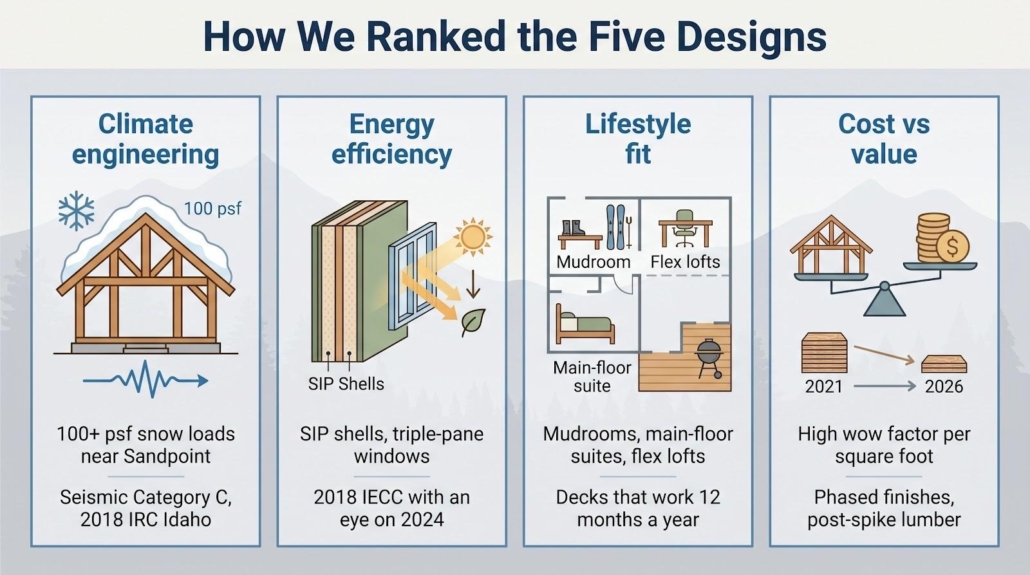
Next, energy efficiency. Idaho already follows the 2018 IECC, and officials are evaluating the stricter 2024 edition. Designs that accept SIP shells, triple-pane windows, and airtight details future-proof both your utility bills and resale value. We preferred layouts that place most glass on the south side and group service spaces to the north; those simple moves cut heating demand without extra gadgets.
Lifestyle fit mattered just as much. Ski families need gear mudrooms, retirees need main-floor suites, and everyone enjoys a deck that works twelve months a year. We chose plans with built-in flexibility: lofts that convert to offices, basements that add bedrooms later, and porches deep enough to grill while the snow falls.
Finally, cost versus value. Softwood prices sit about two-thirds below their 2021 peak, so 2026 is a smarter time to order a frame package. Budgets still vary, so we focused on homes that deliver a high wow factor per square foot and allow phased finishes. Spend on a tight shell today, then splurge on gourmet cabinets when the budget opens up.
When a design excelled in all four areas, it made the list. Five plans cleared that bar. Ready to see the lineup? Here comes the heavyweight that tops our ranking.
1. Green Ridge: the year-round lodge with room-for-company luxury
Green Ridge wears its timber like a custom-fit suit, with elegant king-post trusses outside and soaring hammer-beam frames inside. At 1,899 square feet on the main floors, it feels generous without drifting into “too big to heat.” Finish the optional walk-out basement and you gain two more en-suite bedrooms plus a media lounge, ideal when the whole family descends for ski season.
Walk through the front porch and the great room takes centre stage. A cathedral window arcs toward the view, while the steep 12-in-12 roof keeps that glass clear of heavy snow. Engineering calculations from Hamill Creek Timber Homes, one of the foremost Idaho timber frame builders, rate the frame for roof snow loads exceeding 100 psf. Idaho lenders have already accepted those stamped sheets on projects from the Panhandle to the Tetons, so permitting the design on high-altitude lots stays straightforward.
The floor plan puts owners first. You claim the entire main-floor suite, complete with dual baths and private deck access. Guests stay upstairs in the loft or downstairs in the future basement, close enough for breakfast yet far enough for quiet nights. When it’s just the two of you, you heat and clean a one-bed lodge, and the rest waits its turn.
Green Ridge also delivers energy discipline. A compact footprint limits exterior wall area, and structural insulated panels wrap the frame to reach R-49 roofs and the airtightness targets Idaho inspectors expect. Face the arched window south, and passive solar warmth takes the edge off most winter days.
Cost lands in the mid-$350 to $450 per square foot range. Softwood prices have fallen more than half since their 2021 peak, trimming tens of thousands from final bids.
Who is it for? Retirees chasing four-season comfort, second-home owners eyeing premium short-term-rental rates, or anyone wanting lodge ambience without a 4,000-square-foot mortgage. If you own a view lot and plan to age in place while still hosting the clan, Green Ridge tops the Idaho shortlist.
2. Clearwater: the expandable family basecamp
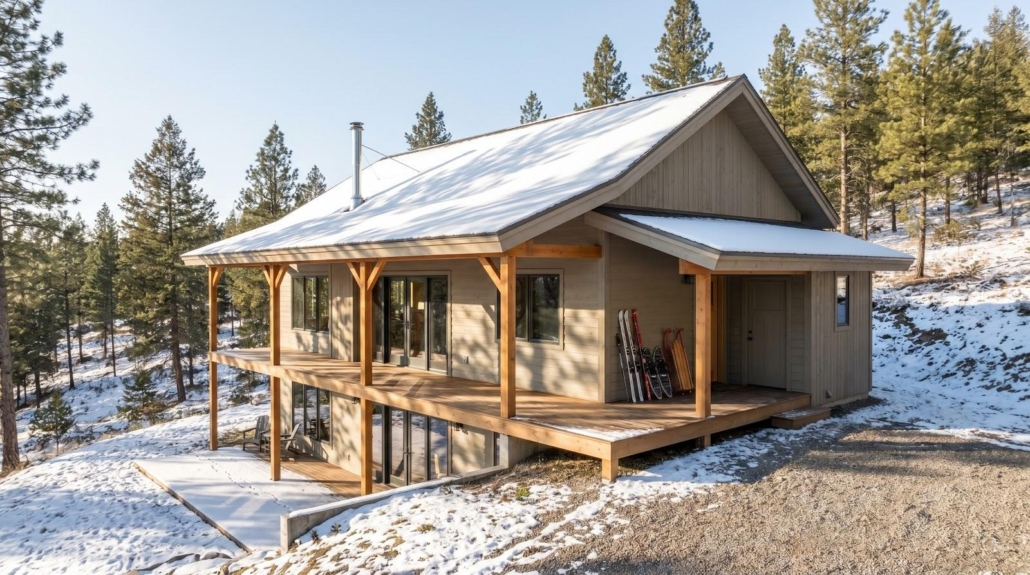
Clearwater shows you can start small without boxing yourself in later. The plan opens at a lean 1,622 square feet, and its optional basement can add four full bedrooms plus a game-ready family room when you need extra elbow room.
Step inside and the hammer-beam great room grabs the spotlight. Tall, unbroken timbers carry the roof so interior walls stay minimal. That openness lets you keep eyes on kids while dinner simmers, and it allows heat from a single wood stove to drift through the whole main floor on sub-zero nights.
Just off the entry sits a combined mud and laundry zone, an Idaho essential. Skis, waders, and muddy boots stop here instead of soaking your hardwoods. River-to-ridge lifestyles need that buffer, and Clearwater supplies it with style.
Upstairs, a lofted primary suite enjoys sunrise light and the hush only a half-story offers. If your household grows, the basement layout slots in four code-compliant egress bedrooms with hardly any structural fuss. Building officials appreciate a plan that already meets Idaho’s 2018 IRC escape and snow-load rules, so your permit path runs smoother.
Energy costs stay tame too. The tight rectangle trims exterior wall area and welcomes SIP panels without awkward jogs. Face the covered deck south, and deep overhangs will shade summer sun while letting winter rays warm the core, a passive move that beats gadgets every time.
Numbers matter. Expect turnkey figures around $300 to $350 per square foot for the above-grade home, then another $150 k or so if you finish the basement immediately. Spread that work over a couple of years and you smooth cash flow without compromising the final vision.
Clearwater suits adventurous young families, short-term-rental investors chasing bedroom count, or anyone who sees a sloped lot and pictures walk-out potential. Build the essentials now, add the extras later, and let the timber stand proud for decades.
3. Larch Cottage: main-floor living in a craftsman shell
Not everyone chasing mountain air wants stairs forever. Larch Cottage answers that need with a true single-level lifestyle wrapped in honest Douglas-fir timbers.
Step through the craftsman porch and every daily essential sits on the ground floor: primary suite, laundry, kitchen, and an easy-flow great room brightened by wide south-facing windows. Door openings are wheelchair friendly, and the shower is step-in, so aging knees and visiting grandparents breathe easier.
Below, a daylight basement hides a flexible rec room and a second bedroom. Keep it as a guest suite, a craft studio, or a quiet office where Zoom calls stay contained. An attached one-car garage finishes the practicality picture, meaning no more chipping ice off the windshield at 6 a.m.
Energy sense shows up quietly. The compact 1,830-square-foot envelope trims heat loss, and when you wrap those timbers in SIPs you cruise past Idaho’s R-49 roof target without foam-board gymnastics. A partly bermed lower level rides the earth’s steady temperature, so it stays cooler in July and warmer in February without extra watts.
Expect finished costs in the $275 to $350 per square foot range, depending on tile and cabinetry choices. For many retirees that places the whole build under $640 k, well below the million-dollar lodges crowding resort listings.
Choose Larch if you want a lifelong home that feels handcrafted yet supports tomorrow’s mobility needs. It lets you live large, stay grounded, and still host the kids for holiday ski trips, all without climbing another flight of stairs.
4. Sugarloaf: the story-book cabin that lives larger than it looks
Sugarloaf resembles the cabin children sketch in crayon: steep roof, dormer eyes, and smoke curling from a stone chimney. Behind that postcard charm sits a hardworking 1,643-square-foot layout built for real Idaho weather.
Push open the timber-frame entry porch and the great room welcomes you with a vaulted ceiling that rises two stories. Exposed beams draw the eye upward, while double glass doors invite you onto a south-facing deck. Summer dinners move straight from kitchen to grill without a bottleneck.
A room off the main living core serves as a quiet office or an instant second bedroom when friends drop by. The full bath beside it ends midnight stair shuffles. Upstairs, the entire loft becomes your private suite. Two dormer windows add headroom and frame sunrise light over the pines, and the open landing grants a perched view across the beams to the fire below.
Snow management comes built in. The roof’s aggressive pitch sheds drifts quickly, and SIP panels seal the envelope so well that a single wood stove handles most February nights. Face the dormers east and west so they scoop cross-breezes in July when daytime highs surprise you.
Sugarloaf also respects budgets and permits. At about $300 per square foot finished, it falls in the low $500 k range, unusual for a full timber frame with cathedral scale. Need more elbow room later? The optional 942-square-foot walk-out basement tucks beneath the shell without redesign, adding space for a bunkroom, gear locker, or rental studio.
Choose Sugarloaf if you want the charm of a classic mountain cottage plus dependable engineering, energy thrift, and room to expand. It balances fairytale appeal with practical foresight, creating a lasting Idaho retreat.
5. Kaslo Cottage: small footprint, full-scale timber soul
Kaslo Cottage packs mountain character into 1,272 square feet. Step from the entry porch into a vaulted great room where a single ridge beam lifts the ceiling skyward. Daylight pours through twin glass doors that open onto a sunny deck, letting the outdoors double your living space in fair weather.
The floor plan works hard. A secondary bedroom and full bath sit on the main level, so single-story living is already possible. Upstairs, the loft becomes an owner’s retreat with ensuite and walk-in closet. The landing balcony lets you enjoy the fire below while preserving suite privacy.
Every inch earns its keep. Built-ins under the stairs corral coats and board games. The open kitchen shares light and heat with dining and living areas, and one efficient wood stove warms the whole volume. With SIP walls and an R-49 roof, the cottage glides through Idaho’s blower-door test without heroics.
Cost shines too. At $250 to $320 per square foot finished, Kaslo often totals under $410 k turnkey. That price makes timber-frame living attainable for first-time custom buyers or anyone adding an accessory dwelling unit to a larger parcel. The smaller frame package also lowers transport fees on remote forest roads, a perk off-grid builders appreciate.
Picture lazy mornings on a deck perched over lake water or a compact guest house that still wows visitors. Kaslo may be the smallest plan in our lineup, but on authenticity per square foot it delivers the full timber experience.
Assess your site
Every successful timber home starts with an honest conversation between you and your land. Elevation, slope, and exposure shape comfort and cost more than any catalog page ever will.
Begin with altitude. A lakeside lot near Coeur d’Alene sees ground snow loads around 60 psf, while a ridge above Sandpoint can top 100. Idaho enforces those values through local amendments to the 2018 International Residential Code, so your roof pitch and truss sizing must follow the map, not your imagination.
Next, read the slope. Steep sites invite walk-out basements like Clearwater’s, turning earthwork into daylight bedrooms instead of dump fees. Flat valley parcels pair better with slab-on-grade plans such as Kaslo, saving excavation dollars you can redirect to finishes.
Sun and wind matter too. South-facing glass in Green Ridge’s arched great-room wall will harvest winter warmth only if trees or peaks avoid casting afternoon shade. A northern gust corridor argues for deeper porches and tucked-away entries, details many Idaho builders already incorporate.
Finally, check wildfire exposure. If your acreage sits inside a county-defined WUI zone, inspectors will expect non-combustible roofing and screened soffits. A plan with simple rooflines makes detailing that metal or Class A composite faster and cheaper.
Spend a weekend mapping these realities. The right floor plan often reveals itself long before you pay a drafter a retainer.
Define your space needs
Square footage tempts, yet daily life depends on how rooms relate, not raw numbers. Before you finance the largest plan on the list, picture one winter Saturday.
Do you drop ski boots in a mudroom at dawn? Clearwater’s gear zone keeps melting snow out of the living room. Do grandkids visit twice a year but FaceTime weekly? Green Ridge’s optional basement hosts them when planes land without forcing you to heat empty bedrooms the rest of the season.
Work from home? You need a door that closes. Sugarloaf’s main-floor flex room serves as an office on Monday and a guest suite by Friday. Retiring together? Larch Cottage lets you live on one level today while hobbies and visitors stay below.
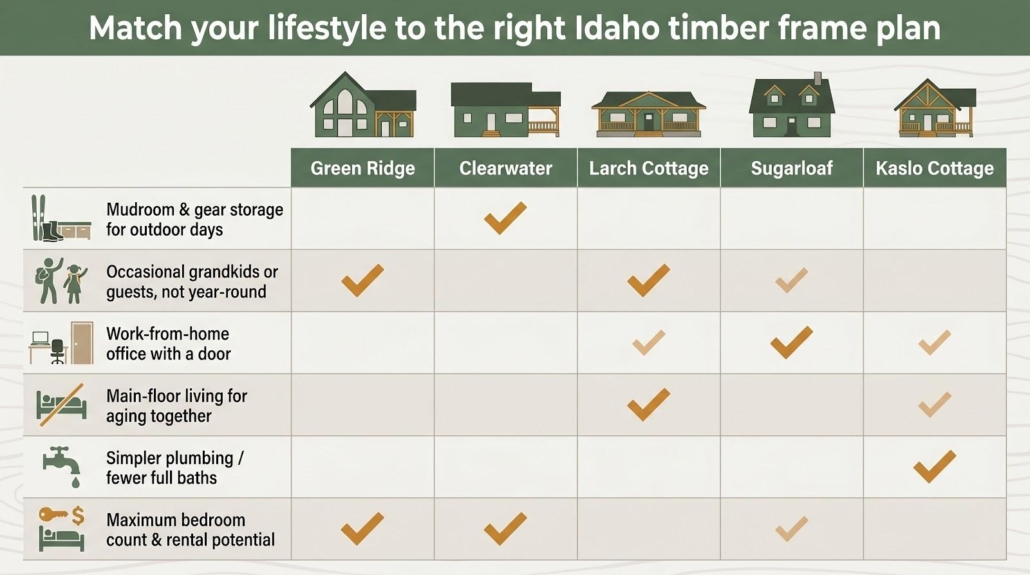
Next, link bedroom count to plumbing. Idaho code requires each full bath to vent and drain correctly, adding both cost and inspection time. A streamlined two-bath Kaslo often meets a couple’s year-round needs with less mechanical complexity than a four-bath lodge.
List your must-have activities first, then choose the plan that meets them in the fewest square feet. You will save build dollars, cut energy bills, and spend more weekends outside the house you came to enjoy.
Budget and phasing
Smart budgets move in stages, not headlines. Instead of asking “What will the house cost?” break the project into shell, systems, and finishes. The timber-frame shell and SIP enclosure secure energy savings and snow-load strength, a payment you seldom regret.
Systems come next. Invest early in high-efficiency windows and a right-sized HVAC package; rebates and lower monthly bills repay you long before granite counters ever will. With lumber prices well below their 2022 peak and inflation easing, ordering a frame package now often cuts five-figure sums compared with pandemic quotes.
Finishes are the flavor layer, simple to upgrade when cash flow rebounds. Clearwater’s basement can stay roughed-in, Sugarloaf’s loft railing can start as pine and swap to steel later, and Kaslo’s deck can wait for a future summer when cedar prices settle. Lenders appreciate this order because the secured structure stands finished while your monthly payments stay lean.
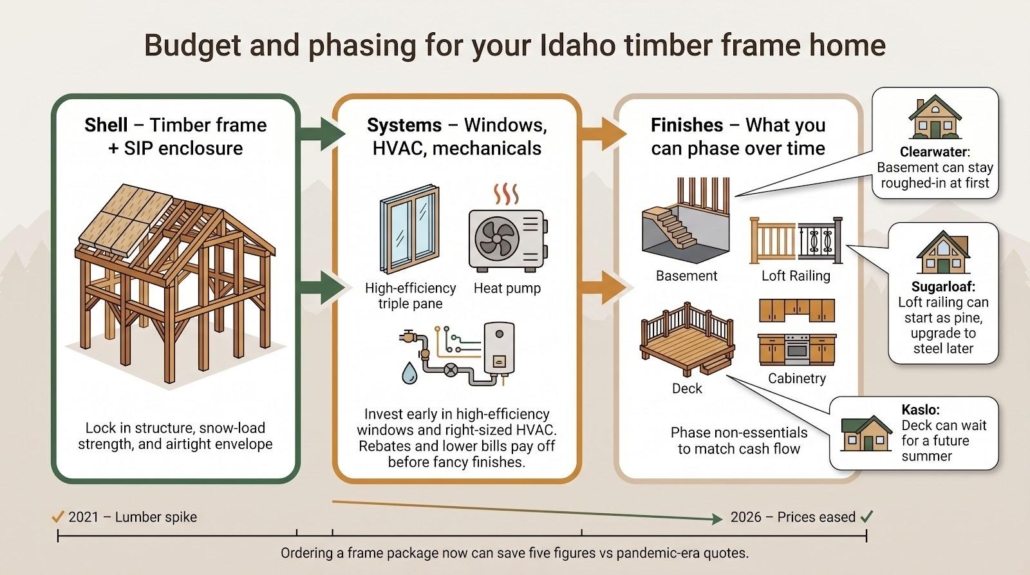
Phase with purpose and you achieve the dream house without the nightmare loan. Even better, you keep the freedom to adjust finishes to the way you live once the first winter teaches its lessons.
Work with local professionals
A brilliant design means little if the crew on site cannot translate joinery into reality or steer your permit through the county office. Idaho’s patchwork of micro-rules and rugged logistics rewards local expertise, so bring the right team on board early.
Start with a builder fluent in timber frames. Raising a pre-cut package follows a different rhythm than stick framing, and crews that have flown trusses in Sun Valley snow know how to keep beams pristine. Ask for addresses of past projects in your climate zone, then knock on doors. Owners will gladly share whether timelines or costs slipped.
Next, hire an engineer licensed in Idaho. Even when Hamill Creek stamps a generic snow-load calculation, officials may ask for site-specific lateral bracing or deeper footings. An engineer familiar with counties that push Seismic Category D details can shave weeks off plan review.
Loop in your jurisdiction early. Some mountain districts approve plans only at monthly meetings, and winter road closures slow inspections. A forward-planning contractor schedules foundation, framing, and blower-door checks before the first concrete truck arrives, keeping the build season on track.
Choose pros who speak timber, speak code, and speak Idaho. You will spend less time translating and more time watching the frame rise against a clear mountain sky.
Conclusion: Build for sustainability and low upkeep
Timber frames already store a forest’s worth of carbon, but lasting sustainability shows up in your chore list. Choose a Class A metal roof plus fiber-cement or stone accents and you reduce wildfire risk and future repaint work. Idaho Firewise rates those materials highest for ember resistance, so you protect the structure and spend weekends hiking instead of staining trim.
Heavy timbers char slowly, buying valuable minutes in a fire event, yet exposed soffits still need screening against sparks. Enclose eaves with fine metal mesh now; it costs far less than a retrofit after an inspector flags open gaps.
Maintenance worries around timber homes are mostly a log-home myth. Structural beams live inside the thermal envelope, safe from UV and rain. Keep exterior trim sealed, move water away with generous gutters, and an annual hour of inspection often covers everything.
Pair that durability with high-performance insulation and your operating footprint shrinks too. A blower-door test below three air changes per hour is standard on well-taped SIP shells, trimming heating loads for the life of the house.
Build once, maintain lightly, and your timber home stays sturdy, efficient, and ready for the next generation to enjoy the same Idaho sunrise that inspired you to build.
Leave a Reply
Want to join the discussion?Feel free to contribute!